Lead Poisoning Is Solvable. So What’s Been the Hold Up?
EPISODE INTRODUCTION:
AMY ROSE
You know that feeling that you get when you just know that something is wrong, but nobody else around you is really concerned about the thing or nobody is really paying attention?
ANGUS HERVEY
Yeah, it's, it's how I feel about my coffee machine right now. It's making weird noises and I don't know how I'm gonna fix it.
AMY ROSE
exactly. I think for me as a mom, it's when I know that something is up with Darcy
AMY ROSE
but he keeps telling me he's fine. Like, everybody around keeps saying that he's fine. I always get to this point where I start second-guessing myself and I think that maybe I'm going crazy.
ANGUS HERVEY
Well, that's pretty much where our guest today found himself once upon a time. Obviously he wasn't worrying about coffee or his kid, he was worrying about something much bigger. Drew McCartor, he's the president of Pure Earth, an organization with one of the best origin stories I think that we have ever covered here on the podcast. Essentially a bunch of hippies, a whiteboard, and a question. A really big, really important question: What problem is out there that everyone else is missing? And for the past 25 years, they have been worrying about the problem of toxic pollution around the world. Since Drew joined the organization 17 years ago, he and his colleagues have become convinced that they were looking at a problem that was far, like, far bigger than anyone realized, and still that anyone kind of realizes today, but nobody was listening to them.
AMY ROSE
What I love about this conversation, Gus, is it's kind of two things. I mean, first of all, it is a conversation about a huge global health problem that most people don't even have on their radar which is lead poisoning. But I also feel like there is It's about something that's much more human. It's that feeling, almost like that loneliness of when you can see something that's wrong and you just keep yelling into the void.
ANGUS HERVEY
And what happens when after 17 years of yelling into the void and banging the drum, the world finally starts listening?
INTERVIEW WITH DREW MCCARTOR
AMY ROSE
Drew, I want you to imagine that you're at a dinner party and you are sitting next to someone you haven't met before, and you tell them that you've spent the last 17 years or so working on lead poisoning What will their response be?
DREW MCCARTOR
It isn't really even a hypothetical. It happens fairly frequently to me, and the response is usually quite similar, and it's, "Lead, huh? Is that still a big problem these days?" Something along those lines, where they— everyone's familiar with the challenge, but usually some skepticism about, "Didn't we solve that already?"
AMY ROSE
Hmm. So what is your follow-up to that?
DREW MCCARTOR
Well, that really opens the door for me to start with some kind of high-level, rather dramatic facts about the toll that lead's really taking today. One of the easiest of those, is just that lead is affecting a third of all kids in the world, which is so large that it almost is unbelievable, and that hooks them a little bit in terms of their attention, because it almost doesn't pass the smell test of being real. The fact of the matter is that our best estimates are that not only that a third of the kids in the world have a concentration of lead above a threshold that the World Health Organization says requires intervention, but if you just look at the low and middle-income countries in the world, it's actually half of all kids. So even though we've made huge progress in rich countries like my country, the US, it's still just taking an almost unbelievable toll in most of the world.
AMY ROSE
I think the number is around a billion children are exposed to dangerous levels of lead. What does that actually mean? What are we talking about here?
DREW MCCARTOR
Sure. One of the things about lead that makes it a little tricky to communicate about is that it's really a sliding scale. There really isn't one number or concentration. On one side, you have lead poisoning, on the other, you don't. Because there's just no safe level of lead in the human body at all. So when we're talking about a billion kids, and you're right on the numbers, it's, I think it's around one point one billion kids, we're talking about that number of kids exceeding what the WHO says just really requires intervention. But the truth is, there's another billion kids below that threshold that are still impacted negatively by this chemical. So even though it doesn't sound like it makes any sense, really almost everyone on Earth is poisoned by lead, just to different degrees.
ANGUS HERVEY
What is the threshold and what happens beyond there? what is the actual impact on the human body?
DREW MCCARTOR
Sure. So the threshold is five micrograms of lead per deciliter of blood. And this is not necessarily a health-based threshold where something dramatically changes. That represents approximately the average concentration of lead in kids in lower-income countries, and at that Concentration, we can expect that a kid would lose between four and six IQ points. We can expect that their risk of heart disease would go up dramatically, that they would be of increased risk of things like, attention deficit disorders, behavioral problems, reduced mood control in a way that when those kids grow up and become adults can lead to increased commission of violent crimes and incarceration, all types of kind of societal ills that we're working hard to avoid, lead exacerbates. And then because it's impacting the brain and IQ, also taking a really big toll on things like learning outcomes and economic development. Your lifetime earnings are related to or are correlated with your IQ. And so if we're, you know, robbing IQ from a billion kids, we're also dragging down economies in countries that are doing everything they can to build up their economies and their standard of livings. So I often refer to lead as like an invisible anchor that is just dragging us down across all sorts of issues that we would never relate to lead.
ANGUS HERVEY
To me, it feels like the sort of industrial fairy cast a curse on us, you know, like two hundred years ago, and then disappeared, and everyone forgot about the curse, but this curse, it still lingers. I thought we'd eliminated lead. Like, I remember in two thousand twenty-one, we reported a story here at Fix the News about how lead had finally been eliminated from gasoline everywhere in the world. Why does everyone still have lead poisoning?
DREW MCCARTOR
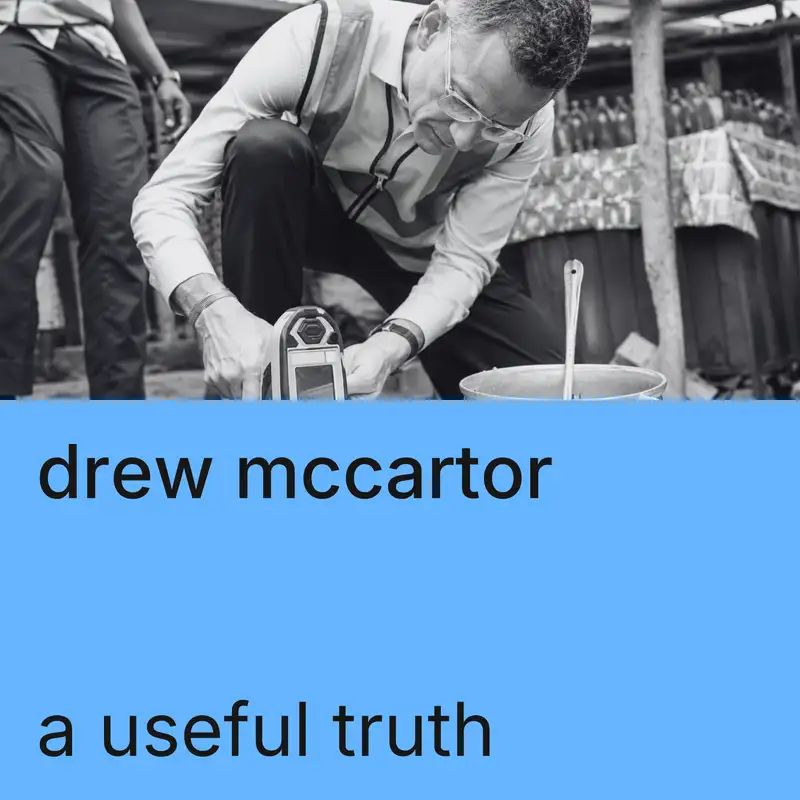
So that brings two thoughts to mind immediately, and one is, like, just how long we've known that this thing is a terrible toxin, and yet have waited to work on it. Some years ago, I ran into a quote from a letter that Benjamin Franklin wrote in seventeen eighty-six, and I always keep this quote up on my computer because I love it so much. He was writing a letter, and he was talking about lead, and he said, "You will observe with concern how long a useful truth may be known and exist before it's generally received and practiced upon."
DREW MCCARTOR
And he's talking about humanity knowing that lead is toxic and just not doing much about that fact. To your point, you're right. We've made dramatic progress on a couple of big issues that I think have kind of lulled us all into this sense of completeness. We removed lead from, gasoline in the last country, Algeria, in twenty twenty-one. And about half the countries on Earth have regulated lead in paint, which are two of the big sources that most people are familiar with. But despite that, lead is getting into all sorts of other consumer goods and being released through industrial practices that just keep these global levels really high. And the sources of exposure are things you might never imagine. You know, like in the US, for example, we talk about old pipes and old paint. Those are the source of exposure that most people are familiar with If you go to Mexico, for example, the number one source of exposure there is ceramic glazes on traditional artisanally produced ceramics. Or if you go to India, you will find that car battery recycling that is done unsafely is a huge emitter of lead. Or Bangladesh had a problem with people adding lead-based pigments in spices.
ANGUS HERVEY
Hmm.
DREW MCCARTOR
And so you just go around the world and you're finding it in all sorts of places where, one, it just doesn't belong and doesn't have a useful purpose. Hmm. And two, that you just wouldn't expect and you can't see.
AMY ROSE
Hmm. You know, the thing, Drew, that I find really hard to wrap my head around is that you are describing a problem that most of us think is solved. It's not solved. It's actually robbing different countries of their future in many ways, and yet we also know how to solve it. So which has been harder, working out how to solve lead poisoning or convincing people that we need to solve it and that it matters?
DREW MCCARTOR
So I don't want to pretend either is easy. But the awareness challenge has been decades long and really hard. and I think that stems to kind of a triple invisibility problem. So on the one hand, lead in stuff in the environment and in products just is materially invisible. You can't see it in cosmetics. If it's in your food, you're not gonna know. If it's in your backyard garden, you won't know. But then it's also kind of clinically invisible. If you bring a lead-exposed child into the doctor's office, the chance that doctor will assume that they, that lead might be a problem or test them is really almost zero, even in high-income countries, just because lead does not have these really dramatic symptoms that a doctor could spot. And then finally, it's kind of invisible in national data. So for example, most countries don't test kids en masse, which means that they aren't aware that they have a big challenge, and if they aren't aware that they have a big challenge, they're not gonna budget for testing. You know, there's no justification for a response. And so That's kind of the third leg of this invisibility stool is when we approach a government, their first response is typically, "Oh, no, we don't have that problem." And then we ask, "Did you test to check?" And they say, "No, we didn't, but we don't have a reason to check because we don't have that problem." And so this has been I think awareness has been, the main thing that we've been working on for many years.
AMY ROSE
I do have to ask, when you signed up for the job at Pure Earth, which I think was back then the Blacksmith Institute
AMY ROSE
as a young lawyer, did you know what you were signing up for?
DREW MCCARTOR
I had no idea. and like many people, my whole career and involvement was very accidental. I moved to New York right after graduating from law school, where I studied environmental law, to go be a fancy lawyer. And I arrived there basically the day that Lehman Brothers collapsed and the Great Recession of 2008, 2009 began. So rather than handing out jobs, you know, most people were losing their job. So I arrived and I spun my wheels for about a year before I realized I was gonna need to work for free somewhere to show them that I could add value and be productive, and the idea of doing that at a law firm was just a soul-crushing proposition. so I thought, "Okay, if I'm gonna work for free, I have to find the absolute coolest, most interesting organization I can." And I found what I think was a Craigslist ad for an unpaid internship at Blacksmith Institute. and that was 17 years ago. Since then, I have held every single job title that the organization uses- between intern and president.
ANGUS HERVEY
Wow.
DREW MCCARTOR
And most of that time working in our programs department, which is where we design and implement solutions, which was just wonderfully interesting to see what worked, what didn't work, and to constantly be learning along the way what the true scale of this issue was. Yeah. Because when we started 17 years ago, there just wasn't any good data on this. So we mostly kept chugging along based on anecdotes from our experience, not because we had these, you know, mind-bendingly large figures that we talked about earlier. It was just a process of kind of micro discoveries of, "Oh, this is bigger than we thought yesterday, and tomorrow we'll realize that it's bigger than we thought today." and only in the last maybe eight years have we had the kind of data firepower to really get the world to notice.
ANGUS HERVEY
It almost sort of feels like a, like a strange story, a movie where you have a bunch of basically concerned hippies who say like, "Hey, we don't want some bad stuff in our food. Let's do something about it." Now, this group happens to catch the problem that affects a billion children. How does a group of concerned citizens, end up becoming, you know, something like Pure Earth today?
DREW MCCARTOR
Yeah. I don't think your characteristic is that far off. you know this was a little bit pie in the sky thinking early on. There were a lot of points where I, and I'm sure our founder, Rich Fuller, second guessed, like, are we crazy? We keep kind of yelling into the void that we think this is really, really big, and no one's listening. Well, I guess we'll just, you know, try to generate more evidence. But there were some key moments along the way that showed us actually, no, we're not crazy. We're really onto something. When the organization was founded, it was kind of like an Engineers Without Borders. We were reacting to problems we had heard about in the world. Maybe this village in Russia is contaminated or this community in India, and we would respond with an engineering solution, dig up some dirt or, you know, adjust water somehow. but it was really reactive. We just hear about a problem and we respond, but how do we know we're working on the right problems? What if there's 100 ones that are worse than the one that we've selected to work on? So then we did a little digging around to see, oh, who in the world has a global database of toxic hotspots? Because we could use that to figure out, you know, the top 10 places to work on or something. And we sniffed around and, you know, the UN Environment, agency didn't have such a database, and the World Bank didn't. And so we realized, oh, we're gonna just have to build that from scratch because otherwise us and anyone else working on this issue is just gonna be throwing darts with a blindfold on in terms of prioritization here. The one that we created is called the Toxic Sites Identification Program. It's still the largest global database of polluted sites in the world.
ANGUS HERVEY
Wow.
DREW MCCARTOR
And the process of creating it, of going to all these places and assessing thousands upon thousands of toxic hotspots really started to build that evidence case where we were like, "Okay, we're not crazy." We have found, in a matter of a few years, 1,500 communities that are being poisoned by lead. And that was just with a couple million dollars and a couple of years worth of poking around. But it made us realize we're onto something, we have a story to tell, and if we keep digging, we're likely to learn that it's worse than we understand, not better.
MIDPOINT REFLECTIONS:
AMY ROSE
Okay, this is where I have to admit something. I don't think I really understood the full impact of lead poisoning, especially what it does to kids, until I watched Drew's TED Talk and until we were having this conversation.
ANGUS HERVEY
Well, if it's any consolation, I don't think any of us did, Amy. I mean, I think that we all knew that lead was a problem, but I didn't understand just how visceral that problem actually is, and how widespread it is, I think.
AMY ROSE
Yeah, and it's, it's weird, right? It highlights the problem with some of these problems. I mean, we've, we've been following this. I remember helping write some of those summaries in the newsletter, but for some reason, I just, I never quite joined the dots between lead poisoning and what Drew is talking about here, which is kids losing IQ points. And when you start multiplying that across, you know, hundreds of millions of children, the global impact is just huge.
ANGUS HERVEY
Yeah, and we've kinda learned to live with it and just sort of It feels like normal because we've never known anything else. But four or five IQ points in a, in a child, it's a lot, because when you shift all of that to the intellectual potential of the entire world population, you are talking about a change that is, that is civilization-defining.
AMY ROSE
What struck me is that this is much less a story about pollution and a story about human potential.
ANGUS HERVEY
Yeah. And Pure Earth, like, they knew this. Like, they have been sitting on that for so long, but they also didn't just sit on it. They just kept on trying to do something about it, you know? They kept on looking. They gathered evidence, and crucially, they were coming up with solutions at the same time as they were finding out how big the problem is and as the problem kept on getting bigger.
AMY ROSE
And that after almost two decades of sounding the alarm, suddenly the world starts paying attention. Yeah. And, you know, where Drew is right now, it feels like the beginning of a whole new story.
INTERVIEW WITH DREW MCCARTOR:
DREW MCCARTOR
A couple of tipping points really mattered here. The first was there is a global public health kind of, data analysis shop called the Institute for Health Metrics and Evaluations. Yes. And I forget the exact year, but around 2015, they included lead poisoning in an analysis product of theirs called the Global Burden of Disease Analysis. The Global Burden of Disease basically looks at what killed everyone who died and what was the risk factor that led to that cause of death. And for the first time, they included lead exposure and started vacuuming up all of the available lead data, and the numbers were shocking immediately. Lead was taking more lives than really well-known diseases like malaria, like HIV, and that it was impacting hundreds of millions of kids. Now, since 2015, those estimates have gone up dramatically. but even when they were smaller, they were a shock to, I think, to the world. And so what we started to do was, put out two influential reports. Now, I will be the first to admit that I'm skeptical of the value of any report. Yeah. I haven't seen many reports move the needle. But in particular, we wrote one with UNICEF, and we said, "We want to write a report on lead, and we think that there's an incredible story of neglect here that impacts children mostly." And luckily, they agreed and were wonderful partners in creating a report called The Toxic Truth. And the headline of that report was what we opened with, that a third of the world's kids are being really dramatically affected by this invisible toxin, and it's totally neglected, and nobody really is aware of the fact that it's taking these huge tolls on the world in terms of economics and health That headline, a third of the world's kids, was so unbelievable that what happened was that report landed on the desks of places like USAID and the World Bank and all of these kind of global movers and shakers, and I think people were tasked with, "This doesn't look right. Young analyst, will you prove it wrong so that we can ignore it?" And slowly but surely, people failed to prove that wasn't the, what the best evidence suggested, and so the report kind of trickled up through all of these policymaking institutions, through donors, and all of these levers of power until, you know, in the last administration in the US, the head of USAID made this a personal mission of hers and put a lot of political firepower behind it.
AMY ROSE
So Drew, it was around 2024 where there was kind of this tipping point where the world really started paying attention to this alarm that you had been sounding. And then at the beginning of this year, you stood on the TED stage. Audacious has given you some funding to scale. Is there something terrifying about finally getting the thing that you've been working toward for so long?
DREW MCCARTOR
You know, the former head of global health at USAID, a doctor named Atul Gawande, I was chatting with him after the TED Talk and after winning this Audacious Project, and he said, "Oh, you're kind of like the dog that caught the mail truck now."
ANGUS HERVEY
Yeah.
DREW MCCARTOR
But your real question was, is it scary to now have more resources available, to have more partners, to have a bigger spotlight on us? And the answer is yes, but it's the best kind of problem. You know, how fortunate to be given the thing that you've been asking for, in my case, 17 years, in Pure Earth's case, 26 years. This is the day that we have always been working toward and dreaming of, where heads of state are aware and asking for our help, where major development organizations are calling us and saying, "How can we get involved?" When donors approach us instead of us coming to them begging for little scraps here and there. So it's a little intimidating, but there's this great ecosystem of kind of thought partners that are all super collaborative. We all know each other, and we talk constantly about best practices. There are great playbooks that exist, so we're not walking in to an issue that is new to us at all or that we have to invent solutions for whole cloth. We've got 26 years of experience, and the thing that we were really lacking was an opportunity to get out there and do the things that we know work.
AMY ROSE
And the timing of this is so extraordinary, right? Because global funding is in the headlines for all the opposite reasons, and it's in this environment that, that you guys are really able to scale. What has this funding unlocked for you?
DREW MCCARTOR
Two things come to mind immediately, and one is kind of the why of why Lead is receiving funding in a time where funding is shrinking for a lot of groups and a lot of issue areas. This is not a comment about any other group or issue area, but I think the thing that has helped Lead in particular is that there is just a tremendous justification in terms of return on investment and cost-effectiveness to working on this. Right. So if you think about other global challenges that we're well familiar with, you know, I suffer sometime from problem fatigue. Like, are we making progress on climate change? I'm not sure, and I don't know what we should be doing differently exactly or how to get it done. I don't know what levers of change I can pull personally exactly. That's not a knock on climate or any other issue, but this one is just very solvable, and the reason that we haven't made progress isn't because we need a fancy new technology or something like that. It's just because it was totally neglected for decades and decades and even centuries. So that's why I think in a period of contracting resources, the donors that are left are out there kind of shopping for what is a really solvable problem where we're not working on the most expensive last mile of the problem, but where we can work and get huge gains from working on the first mile of a totally neglected problem, and Lead kind of slots into that. And now I've totally forgotten the second part of your question, if you could help me.
AMY ROSE
The scale, what does this unlock for you?
DREW MCCARTOR
Yeah. So there are three big initiatives, we're part of all of them that are adding to scale. A donor group called Coefficient Giving has a Lead fund, and they are funding us and many other groups. Bloomberg Philanthropies announced a big push on lead poisoning And we were a finalist in a, funding aggregation platform run by the TED organization called The Audacious Project. All three of those are bringing, scale of resources to bear that were unavailable just two or three years ago. And what it allows for is a three-step model to be rolled out in dozens of countries around the world. So to talk about how to prevent lead poisoning, the first step that we advocate for, that these resources allow for, is a national survey, where you test kids' blood to understand how much lead is in their blood. Step two, each of these countries has its own unique exposure sources. and you can't walk into a country and just assume that country A's problems are gonna be the same as country B's problems. So these, this increased, resource availability allows us to go in and test country by country what's making people sick here. Is it the leafy greens? Is it the cheap aluminum cookware? Is it the industrial practices? So that you don't waste your time and money working on things that just aren't that country's particular issue. And then three, targeted mitigation efforts. So if that is food contamination, then that means, okay, let's spend concerted time with this government talking about industrial emissions. Or if it's spices, let's go into marketplaces and conduct, educational campaigns with sellers and all of this stuff. So three different steps. All of them require time and awareness and resources, and those three steps you're gonna see increase dramatically over the coming years.
ANGUS HERVEY
Drew, can you kind of boil this down to just one example of, like, a village or even a person or a family that has changed as a result of one of these solutions being applied?
DREW MCCARTOR
In my TED Talk, I described, a family we met in Bangladesh. This family lived in a small village where some men leased a plot of land to recycle the lead out of old car batteries. Now, a car battery, the kind of heavy plastic box that's in the front of most cars, it's basically 60% lead and 40% acid, and that's why it's so heavy, and the lead in there is valuable, so no one on earth really throws away car batteries. They're all recycled because they have maybe 40 or 60 bucks worth of lead in them. So in this one village in Bangladesh, some men leased a plot of land. They started pulling the lead out of these batteries and just melting them down in an open fire, particularly at night, and this threw up tremendous amounts of lead dust all across the community, where kids are playing and going to school and messing around outside. These two young brothers of this family We tested their blood and found that they had really acute lead poisoning. They were— had the highest levels in this village of several hundred people. but even aside from the levels in their blood, their parents came to us with no knowledge of concentrations, and they said, "Our boys need help. They used to do— be doing really well in school, and they were just normal, lovely boys who excelled, and today they just are different. They are almost falling out of school. They're so far behind. They're struggling to learn anything new. They're struggling to remember common sense things that any child should know." And when we interviewed one of them on camera, our interviewer was just asking some regular questions. He was asking this boy named Saim, who at the time I think was nine, and he said, "Saim, you know, what grade are you in?" And Saim said, "I'm in second grade." And he said, "Oh, what school do you go to?" He said, "Oh, I go to Hazabari School." He's like, "Oh, who are your friends in school?" And he said, "Oh, my friend is Mim, and Mim is in third grade with me." And the interviewer says, "Wait, third grade with you? Didn't you, didn't you just say that you're a second-grader?" And you see Saim on film pause for a minute and then look confused, and then he just replies as honestly as I've ever seen anyone say anything I don't know. I, I don't remember. And he's talking about his grade level, and he just doesn't know. I've been working on lead for 17 years, and I've never really found as poignant a moment that shows what this does to a human child. I have a daughter Saim's age. I have a 10-year-old, and if I were to mistake her grade level in front of her, it would be a half second before she started hollering the correct grade level. You know, this matters to kids. It's part of their identity, and they don't get it wrong. and Saim didn't know.
AMY ROSE
And Drew, just to clarify, once that impact has landed, there is no cure. There's no regaining those IQ points?
DREW MCCARTOR
This is true, unfortunately, for the intellectual damage that lead causes. So lead has two impacts on the body that we worry most about. It has many impacts, but the two that we worry most about are brain damage, which is irreversible once it occurs in a child. and the second is heart disease that happens later in life, and available evidence suggests that the heart disease risk can go down if you prevent exposure earlier in life. So there's great value in reducing exposure to someone that's already been exposed to lead, but they will not repair the brain damage. And that is why an organization like ours focuses almost entirely on prevention
AMY ROSE
Yeah
DREW MCCARTOR
and prevention in the earliest stages of life, even before birth. Because, in fact, the most vulnerable moments of life are in the womb, where the brain is, at that moment, creating billions of synapses and is growing kind of out of nothing. And if lead is up in the brain, the brain will use lead to do things that it just can't do in the building of these, you know, synaptic connections and just wire in a way that can't be unwired.
AMY ROSE
That just brings home the urgency of what you have been trying to do and why you have been sounding the alarm as an organization 25 years.
DREW MCCARTOR
Yeah. But, you know, to— I wanna make sure that we kind of keep an eye on the fact that prevention isn't a Sisyphean task where we're trying to, you know, move this unmovable boulder up a hill. We just haven't tried very hard. - Right and once you have a little bit of government buy-in and a little bit of resources, the fixes are not rocket science. So fortunately, even though the stories of personal impact are devastating, we cleaned up Saim's community. That local magistrate is not ever going to allow someone to recycle lead in that district again. That community is clean, and that lesson is learned there, and we just keep on marching, community, state, and country by country, until this is solved.
ANGUS HERVEY
Drew, what happens if you raise the average IQ of a billion children by six points globally?
DREW MCCARTOR
Yeah. So this is super interesting because, you know, we can talk about a case like Saim and describe how it affected his life and brain personally, but when you do this on a macro scale, if you do it in a country like India with, I think, around one point four billion kids, even if those kids are only losing four to six IQ points, the societal impact is absolutely staggering. And in my talk, I have a nice visual that shows a curve, a regular distribution bell curve, and in the middle of that is an IQ of one hundred, which is the human average. Most of us sit somewhere near that. And then on the tails, of course, you have a population that has extraordinarily high IQ. These are often referred to as gifted kids, and a population at the other which classify as intellectually, disabled. If you shift that average from 100 down to 95 or up to 105, you move these extremes by 50%. Meaning if we move from 100 down to 95, which is likely the case for many countries in the world, that is already what has happened, you cut in half the gifted population by over 50%, and you add to the intellectually disabled population by over 50%. So this is just a tremendous intellectual capital loss. These gifted kids hopefully are going to be the future leaders, the innovators, you know, the thought leaders for these countries that are not only gonna, you know, be working on issues like lead. We have all sorts of challenges approaching us in the future. You know, there's no shortage of challenges that we're gonna need incredibly smart people to be working on the future, and lead is just emptying that pool of talent and intellectual capital.
ANGUS HERVEY
I mean, on the whole, this feels like a solution whose time has come. Is there part of you, and maybe other people in the organization that are just a bit annoyed that it took this long? You know, like, where were you guys? Like, we've been banging this drum for so long. Where were you 10 years ago? Where were you 15 years ago?
DREW MCCARTOR
It would make sense for that to Yeah a strong emotion. And I, for whatever reason, it isn't one that really permeates our organization or I think others. Mostly it was just relief that we weren't positive this day would ever come.
ANGUS HERVEY
Yeah.
DREW MCCARTOR
And here it is, and now we just have an enormous responsibility to make sure that the opportunity that we've been given isn't squandered. Because what a tragedy would it be to work for 26 years to arrive at today
ANGUS HERVEY
Yeah
DREW MCCARTOR
and then waste it on some ineffective solutions or having retreats in the Bahamas instead of just getting down to the business of solving things. But I also wanna point out that while awareness and resources have grown a lot in the last couple of years, it is still nowhere near commensurate to the size of this challenge.
ANGUS HERVEY
Yeah.
DREW MCCARTOR
We're talking about a problem that annually is estimated to drain the global economy to the tune of $6 trillion. So that's just the economic harm side. And even though we've moved up from spending $15 million annually addressing it, I don't have a firm figure of what we're spending today, but it's not more than, I don't know, 50 maybe.
DREW MCCARTOR
So the uptick has been dramatic. Hopefully, that is just the first increment up from many more to the point where our response to this is somewhere at the scale of the challenge. Because today we're, we're doing well, but we still have a mighty hill to climb.
ANGUS HERVEY
All right. I— my laptop is about to die, so I'm gonna try see One more
AMY ROSE
question
ANGUS HERVEY
I'll see if I can get this question in. what's possible
DREW MCCARTOR
What's possible is eliminating lead poisoning, full stop. And here's why I think that. In the US between around the late '70s and today, we reduced the concentration of lead in US children by around 94%. It's not zero, but that's close to a total solution. There is no reason why that can't be done in every country on this planet. Lead is not required for almost anything. It's needed in certain types of car batteries, in that vest you wear when you're getting an ray. We still use it in fishing weights and in bullets. But almost nothing else needs lead. Those things don't need lead for that much longer. So this is a chemical whose time has come in terms of industrial usefulness, and it was never valuable to the human body. Unlike many other metals and nutrients, this one has no place in the human body. It has no place in our economy. It has no place in our environment. And we can get to a day where it's not, where it's not in any of those things.
AMY ROSE
I'm just interested in if you could go back and talk to that young lawyer that walked into that unpaid internship, what would you tell him?
DREW MCCARTOR
You know, this is a message that I would love to share From that experience, I learned that if I had too much ego or too much self-importance to take as a 30-year-old law school graduate, an unpaid internship, I would've missed out on a career that I could not imagine being more interesting and rewarding.
DREW MCCARTOR
If I had too much self-importance to say, "No, I'm a lawyer now," or, "No, I'm in my 30s and this is beneath me," I would've missed the world. And I'm just so glad that 30-year-old Drew saw that as a viable path and an opportunity and not something beneath him. Because it wasn't, and it was the most important choice, aside from my wife, that I've made.
ANGUS HERVEY
Thanks, Lehman Brothers.
FINAL REFLECTIONS:
AMY ROSE
I just can't shake that point that we started with, when you know that something is wrong, but nobody else really seems concerned about it.
ANGUS HERVEY
Yeah. And you're like, "Am I crazy? Am I, am I-" losing my mind here?" It's like, "Should I be worried about this? No, I know I need to be worried about this, but, like, why is no one else worried about this?"
AMY ROSE
I know. And what I love about this story in particular is it wasn't like there was one eureka moment where everything kind of sorted itself out. They kept looking, they kept finding evidence, and they just kept sounding the alarm.
ANGUS HERVEY
Yeah. And I think what's even crazier is that this is not just 17 years old. I mean, we have known about this problem for a lot longer. It's it's been centuries in the making. you know, as I it goes right back to the dawn of industrialization.
AMY ROSE
Like, you know when he spoke about that letter that Benjamin Franklin wrote?
ANGUS HERVEY
Yeah.
AMY ROSE
It reminded me a lot of the conversations that you and Ada have been having on The History of Saving the World podcast about these ideas are here sometimes for hundreds and thousands of years, but it's just when the right time comes.
ANGUS HERVEY
Yeah. And also that we have been trying to save the world for a very, very long time, you know? like, I think that's what the crazy thing is it's we know how to stop this. You know, we know how to clean up contaminated communities. We know how to regulate the sources, and everyone is on board. No one says, "Oh, we want more lead poisoning." Everyone is like, "Nope. That's great. Let's get it out here." So everything was in place, but what was really missing was attention on the actual problem itself.
AMY ROSE
And doesn't it just make you question how many other problems are currently in the we've already solved this box, or no one's really paying attention box, and that there is someone somewhere right now kind of yelling into the void?
ANGUS HERVEY
Yeah. I'm sure they're out there. We will try to find them.
ANGUS HERVEY
And I hope that they have not been yelling into the void for 17 years as well.
Creators and Guests