Education Rebuilding Communities: Girls, Healing and Hope in Northern Uganda
Alice Achan:
Sometimes you don't want to sit down and make yourself hopeless. Situations happen where we have to get up and make a positive move and take action to defeat shame. I call it defeating shame, because when you sit down, you become shameful. But getting up and taking action is a defeat of shame.
INTRODUCTION
Amy Rose:
Welcome to Fix The News. I'm Amy Rose.
Angus Hervey:
I'm Angus Hervey. And these are stories from the front lines of progress.
Amy Rose:
Angus, I want to talk about our giving because I feel like it's something we haven't really spoken about a lot on this podcast.
Angus Hervey:
Yeah, and it's something that really matters to Fix The News. It's right at the centre of the work that we do.
For those of you who don't know, we donate 30% of all of our subscriber revenue to small charities making an outsized impact somewhere in the world. It came about when we launched paid subscriptions about five years ago. I remember thinking: we can't just report good news. We have to be an organisation that also helps make good news happen.
That always seemed obvious to me. And it's been incredible to watch the giving arm of the business grow and evolve to the point where I can't imagine reporting the news without it.
Amy Rose:
I don't know if you'll remember this, but the first time I really became involved was in 2021. I'd just written the Humankind piece about Shabana Basij-Rasikh and the girls' boarding school in Afghanistan after they evacuated from Kabul when the Taliban returned.
You phoned me and said, "Amy, you have such a connection to this story. Why don't you contact them and see how we can help?"
Those words — see how we can help — really sit at the heart of our giving. You didn't say, "Let's write them a cheque." You said, "Let's see how we can help."
That was when I realised we had an opportunity to do something different.
Angus Hervey:
That's important because we're a news organisation. The thing we do best is bring attention to something.
We can do that by reporting on a story. But we can also bring attention to something by making a donation and then, hopefully, bringing our readers and subscribers along with us.
And this conversation you're about to hear with Te-Kworo Foundation is such a great example of that.
Amy Rose:
This was a huge turning point for us.
Te-Kworo runs a boarding school for girls in northern Uganda, supporting young mothers and vulnerable girls. Last year, their intake exceeded expectations and suddenly they had more than 200 additional girls without enough beds. Many were sleeping on the floor.
They reached out to us for help. We donated around A$12,000, which funded 100 bunk beds.
But what happened next was extraordinary. We received an email telling us that our subscribers had almost doubled our donation.
Angus Hervey:
That was a real moment of thinking: okay, we can bring people along on this journey.
We don't have to be the only people putting much-needed funds into the hands of organisations doing incredible work.
And what I love about this conversation is that we get to go much deeper with someone who's been part of our network for more than a year. There are parts of this story that we didn't even know existed until Amy sat down with Alice.
Amy Rose:
This is a particularly special conversation because Alice actually came to Sydney.
The team at 101 Podcast Studios in Balmain generously offered us their facilities, which meant we were able to have this conversation face-to-face.
INTERVIEW
Alice Achan:
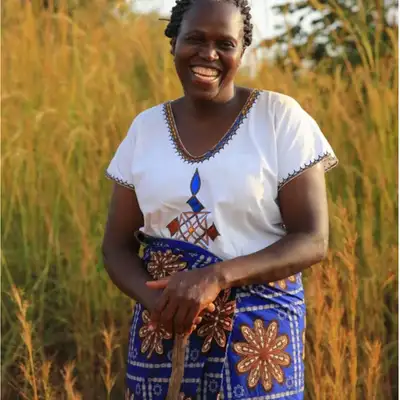
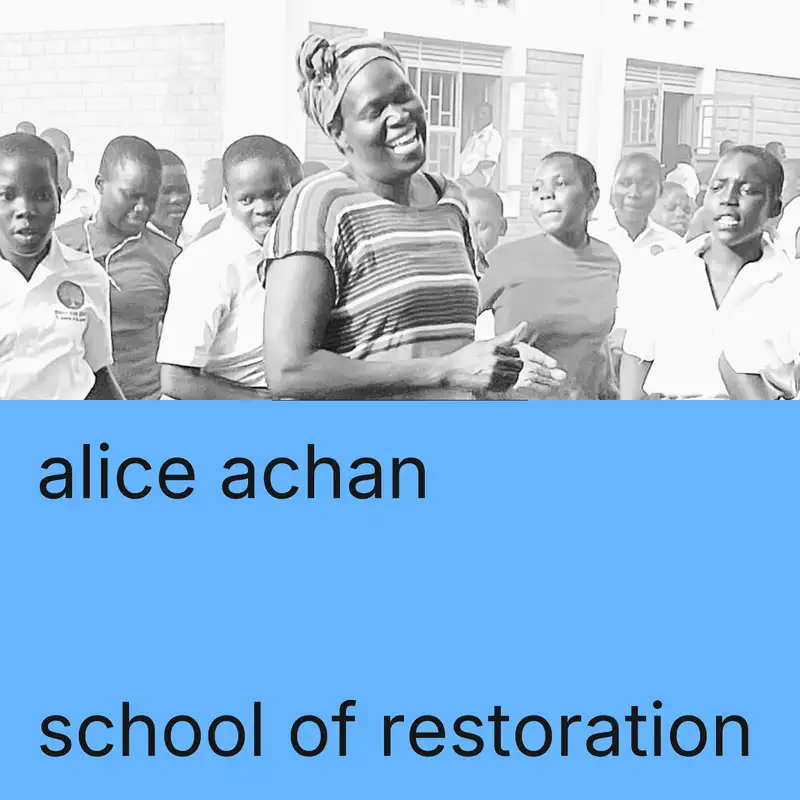
My name is Alice Achan, and I am the director of Te-Kworo Foundation in northern Uganda.
Our work focuses on creating access to education for vulnerable girls and young women, giving them a second chance.
Many of the girls in our school have experienced sexual violence as a result of the long conflict in northern Uganda. Many became pregnant at a very young age and lost the opportunity to continue their education.
Our school creates a pathway for these girls to return to school, continue learning, and rebuild their futures.
We also created a daycare program so that young mothers can live in a boarding environment while their children receive care and nutrition.
It is a very unique approach to education, and I believe we may be one of the few schools in Africa offering this kind of model.
Amy Rose:
I mean, it's such a holistic model. You've got the boarding school, pregnancy care, a crèche, and now healthcare. You also describe it as a *School of Restoration*. What does healing look like for a student at your school?
Alice Achan:
The School of Restoration is based on our different approaches to learning and education for young girls.
First of all, we provide psychosocial support and social intervention right from the family level. Then, when girls come into the classroom, education is not only about academic learning. We believe in integrated education.
Our girls participate in sports and games, and this has helped many of them discover their strengths and talents in different areas. We also focus on practical skills, particularly agriculture. Much of Africa is agricultural, so we help our girls develop skills in food production.
In that way, they are able to grow their own food and, when they leave our school, they have a range of practical skills that can support their futures.
The school restores opportunities that many of these girls lost when they were forced to leave education.
Amy Rose:
It's now widely accepted that education is one of the surest pathways out of poverty. But what does that look like on the ground? What starts to happen to a community, a region, or even a country when young women and girls gain access to education?
Alice Achan:
Education has been one of the most important tools for reducing poverty in our communities.
Our girls and their families have witnessed its value firsthand. For example, many people know my family and understand the circumstances we came from. My father was once a wealthy man with many cattle, but when the war came, we lost everything.
Because I continued my education, I can now support my entire clan.
Families that understand the value of education are more likely to send their daughters to school. But the pressure from society and culture remains one of our biggest challenges.
In many communities, once a girl reaches 15 and begins to mature physically, people believe it is time for her to marry. That is the mindset we are working to change. Just because a girl becomes physically mature does not mean she is ready for marriage. She still has a long way to go.
That is one reason why many of our schools are boarding schools. We keep girls in a safe environment where they spend most of their time learning, developing skills, and building confidence.
When girls are in school, they begin to realise: I am safe. I can learn. I can grow. I can build a future.
Many mothers in northern Uganda never had the opportunity to receive an education themselves. When a woman has not experienced education, it can be very difficult for her to advocate for her daughter to stay in school.
Many decisions are still made by men. Even during marriage negotiations, the mother is often not involved, and neither is the girl herself. Decisions are frequently made by male relatives and clan leaders. That is why education is so important. It changes not only the life of one girl, but the future of entire families and communities.
Amy Rose:
These cultural traditions are deeply entrenched and have very deep roots. How do you navigate trying to create a completely different future for these young women while also respecting those cultural traditions and boundaries?
Alice Achan:
We work through many of the traditional structures that already exist in our communities.
We have strong support from the Catholic Church, the Anglican Church, and the Pentecostal churches. We use these networks to talk about some of the cultural practices that negatively affect women and girls. We also use radio extensively. We go onto local radio programs and speak openly about these issues.
But perhaps our most powerful tool is the girls themselves.
The first girls who came through our school have become our strongest ambassadors. People see that they are working, earning an income, and living better lives. Their success sends a very important message to the wider community.
Today, many families say, "I want to send my daughter to Te-Kworo because I want her to have that future too."
Scholarships have also been incredibly important.
There are often two reasons girls are married early: to create wealth for the family and to reduce financial pressure. If a girl marries, a family may receive cattle or money through the bride price. That can be a powerful incentive.
But when families know that education is affordable, and when scholarships reduce the financial burden, many parents choose to send their daughters to school instead. We now see many parents who genuinely want their daughters to study and build a different future.
Amy Rose:
You also haven't stopped at education. You now have two ambulances that act as mobile clinics. You've helped establish a hospital. The girls at your schools also have access to healthcare. Can you tell us a little about how healthcare became such an important part of Te-Kworo's work?
Alice Achan:
The health program at Te-Kworo has a long history.
In 2008, one of our girls returned from the Lord's Resistance Army. She was six months pregnant. She contracted malaria and became severely anaemic. This was still during the difficult years after the war, and sadly she died.
The whole school went into mourning. The girls asked a very important question: How could we survive bullets and war, only to die from malaria?
That moment changed us.
Many of our students decided to study nursing and midwifery. When they completed their training, they said, "We want to return and help our communities."
By 2016, as the war had finally ended, many of these young women chose to work in their own communities, supporting other women and girls. There are still very high rates of teenage pregnancy and early pregnancy in northern Uganda, often as a result of violence and conflict.
Our graduates began providing maternal and child healthcare, antenatal services, and support for vulnerable mothers. Many now work in maternity facilities. Today, these services have grown significantly. Through partnerships with medical donors, we are building a 42-bed maternity hospital.
We also continue to run mobile clinics because antenatal care is often the first point where vulnerable mothers can be identified. It allows us to listen to women's stories, understand their needs, and connect them with support and education.
The mobile clinics have become an important way for us to reach women and girls throughout the community.
Amy Rose:
You've created this whole ecosystem. The girls who have come through the school are now working in the health clinics and the mobile clinics. It's incredible.
Alice Achan:
We know that when you combine education and healthcare for women, you reach most of the community.
Health and education are the greatest opportunities we can give to women. A healthy woman gives birth to a healthy child, and an educated woman can make informed decisions about her own life and wellbeing.
Amy Rose:*
And it's all connected, right?
Alice Achan:
Exactly. I would say this is the greatest form of empowerment we have been able to give our girls.
MIDPOINT REFLECTIONS
Amy Rose:
The thing that blows me away most about Te-Kworo Foundation is how holistic this model is.
Not only are these young mothers receiving an education and living at the school, they also have access to healthcare. Then some of those students go on to become nurses and midwives, return to their communities, work in the clinics, and help identify other girls who may need support.
It becomes this remarkable circular model.
Angus Hervey:*
What it makes me think about, Amy, is that so many of the people we speak to aren't simply incredibly hardworking people with huge hearts. Very often, they're also doing something remarkably smart.
There's usually an innovation, a clever idea, or a model they've developed that allows their work to go much further than traditional charity alone. It enables them to create much larger impacts and helps the solution actually take hold. It's a good reminder that you need the smart alongside the heart.
Amy Rose:
What's interesting, though, is that this hasn't come from unlimited resources. It hasn't come from sitting down and creating a ten-point plan or a five-year strategy. This is what happens when you're deeply immersed in the work itself - constantly looking for opportunities, responding to challenges, and adapting as you go.
Angus Hervey:
Exactly. It's a very different kind of ingenuity from the sort we often see, where people think that if they simply draw the right diagram or write the right strategy document, the solution will appear. That's not how it works.
You have to be in the work. You have to get your hands dirty. And then, from inside the work itself, you find ways to improve it and develop smarter models like this one. That's what makes organisations like Te-Kworo so inspiring. The sky is the limit for organisations like this.
INTERVIEW
Amy Rose:
What's really incredible is that all of this began in a place of trauma and conflict.
You were around 13 years old when the Lord's Resistance Army came to your village. Can you tell us a little about what life was like before the war, what happened during it, and what happened afterwards?
Alice Achan:
As a young girl, I grew up in a typical African home where boys were considered more important to educate, while girls were often seen as a source of wealth and labour. A girl was expected to marry when she was 14 or 15 years old.
I remember my mother very clearly. She was the youngest wife in a polygamous family, and we would often go with her to work in the fields. She would sing these sorrowful songs, and I would see tears running down her face.
As a child, it was painful to watch my mother cry, but I could not fully understand what she was going through. As I grew older, I began to see the challenges she faced within the family and within society. I made a decision that I wanted my life to be different, and that somehow I wanted to help make my mother's life different too.
When I went to school, I admired my female teachers. I would think, if my mother had been given this opportunity, perhaps her life would have been different. So I worked very hard because I wanted to become something different.
But when I was 13 years old, the war came.
The rebels entered our communities and everything changed. Schools closed. People fled. We ran day and night and hid in the bush. Many of my friends were abducted. Many were killed. Those who returned came back with terrible experiences. Some had children. Some had bullet wounds. Many young girls returned pregnant.
That worried me deeply.
Fortunately, my brothers had already completed their education and found work. They helped me move to the city, where I was able to continue my studies. I completed a diploma in social work and social administration.But the war was still continuing.
At the same time, HIV/AIDS was devastating many families, and treatment was not yet available. I lost a very close relative who left behind a six-month-old baby. I took that child in and cared for her as my own daughter. She had already been infected with HIV.
I devoted all my time, my energy, and my resources to helping her survive. But because there was no treatment available, she eventually died.
That was a turning point for me. I reached a place of complete hopelessness. I wanted to die.
I returned to my village while the war was still continuing because I simply wanted to be with my community. I felt that if we were going to die, then we would die together. But when I arrived, something changed. I saw the women I had grown up with. Their lives had been devastated. Many had lost everything.
I realised that I needed to help them. We started gathering together as women. We prayed together, talked together, encouraged one another, and shared our experiences.
The name Te-Kworo* means "under the tree." Kworo* means tree, and Te means under.
During the war there were no houses, no buildings, and no safe places to gather. So we met under a tree.
That tree became our support group.
It became a place where women gave birth, where girls received treatment, and where the first lessons of education began. At that time, I had to put my own trauma aside. I carried my grief inside me, but I wanted to walk alongside these girls.
Many of them returned from captivity with babies. Some were pregnant. Because they had children fathered by rebels, they were rejected by their own communities.
I realised that perhaps I could not stop the war. But I could do something small to change the lives of these girls. I did not have the power to stop the conflict. But I did have the power to change a girl's life.
Amy Rose:
Once you returned to your village, before you started meeting under the tree, you were already a trained social worker. Was there a particular moment when you realised not only that you wanted to help these women, but that you were actually someone who could help?
Alice Achan:
There was one particular girl who had been abducted.
When she returned, both of her parents had been killed. She was completely alone and living on the streets. At that time, I was still working, and I brought her to live with me in my small one-room house.
I connected her with a tailor so that she could learn some basic skills. Within a few months, she was able to make clothes for herself and for her child. She gave birth while she was living with me, and I helped care for both of them.
As I watched her change, I saw her confidence return. She began earning some money. She became positive about her future. And that gave me another kind of motivation.
I thought: If this young woman, who had experienced so much trauma, who had been in captivity and endured so many hardships, could begin to rebuild her life, then why not me?
Something inside me simply said, Get up and do it. Get up and do it.
Amy Rose:
It speaks so powerfully to the resilience of women and to the ability to rise again and again. But where did you actually begin? You're in your village, at the end of a war, and you probably don't have many resources.
How did you go from gathering under a tree and running a refuge centre to building a school?
Alice Achan:
At first, we were simply living together in a shelter in the middle of the camp. After about a year, organisations like UNICEF and Save the Children began arriving. They brought large tents because many women and children were living outside in difficult conditions.
Save the Children helped build a temporary shelter where the young mothers and their babies could stay.
Several years later, the rebels moved into the Democratic Republic of the Congo, and the conflict in northern Uganda began to ease.
At that point, we turned the tents and temporary buildings into classrooms and dormitories. The girls kept telling us, "We want to go back to school. We want to continue our education."
Our first major support came from the MacArthur Foundation in the United States, which helped us build our first school buildings.There were three rooms. One became a classroom, one became a dormitory, and one became a teacher's room and a small daycare centre.
That is how we began. From the tree, to the tents, to the classroom.
Amy Rose:
To a classroom. And now to three different campuses?
Alice Achan:
Yes.Today we have three campuses. The original campus in Pader has more than 800 girls. The second campus in Nwoya has more than 200 girls, and the campus in Kitgum has around 50 students. Altogether, we now serve more than 1,000 girls.
Amy Rose:
Is there one story of a girl - and I know there must be so many- that really stands out to you?
Alice Achan:
There is one young woman I often think about. She was married to a banker, but eventually her husband left her and abandoned her with two children. Her father brought her back to our school.
She completed Year 10 and then Year 12. And now, as we speak, she is preparing to go to university to study business administration. She tells me that she wants to become a banker herself.
For me, this is a positive kind of competition. It reminds me of something very important. Sometimes you cannot sit down and make yourself hopeless. Difficult situations happen, but we must get up and take action.
I call it defeating shame. Because when you sit down, you become ashamed. But when you get up and take action, you defeat shame.
Amy Rose:
And if you can defeat shame, you can change so much. You can also empower other people.
Alice Achan:
Because when you live in shame, you cannot do anything. You become like a carpet that everybody walks over. But when you stand up, you roll up the carpet and you walk with your head held high.
Amy Rose:
And there are so many ripples from this work. The girls who are in school today are changing the future for their children as well. How has doing this work helped your own healing?
Alice Achan:*
It is difficult to describe, but I feel a great sense of satisfaction. I am now 53 years old, and after 23 years of this work, I can see what we have achieved.
We have created access to education for women and girls. We have shown that even if a girl's education is interrupted by pregnancy, teenage pregnancy, or an unwanted pregnancy, there is still a pathway back to school.
A young mother can study with her baby. She can receive maternity care. She can continue her education.
To me, this is one of the greatest achievements for women in our country.
Seeing the change in our students - from the day they arrive to the day they graduate — has been a great source of motivation, comfort, and healing for me.
Amy Rose:
What would you say is the biggest lesson you've learned?
Alice Achan:
The biggest lesson is partnership and collaboration.
Nothing we have achieved has come from one person or one foundation alone. It has come from people who believed in our story and believed in our vision. Partnership means financial support, but it also means people sharing skills, expertise, and encouragement.
We have wonderful partnerships with Australia. When we had problems with accommodation and beds for the girls, you helped raise support so that we could buy bunk beds.
That is the power of partnership. Without your listeners, without people saying, "These girls need beds," we would not have been able to do it. One of the most important lessons in this work is that good partnerships allow us to mobilise resources, skills, and expertise that no one organisation could provide alone.
Amy Rose:
If you had all the resources you needed to continue growing this school and this vision, what would the future look like?
Alice Achan:
I would love to create a university for girls. I want to see more girls studying science, technology, medicine, and other high-level professions because we are living in a scientific and technological world.
Even if it were a small institution, I would like to see a university in northern Uganda that helps our girls continue their education and reach their full potential.
Our schools now go through to Year 12, and we want our students to continue to university. I would especially like to see more girls become doctors, nurses, and midwives.
Northern Uganda still needs healthcare workers, particularly women who can support maternal and child health. These issues still place a heavy burden on women. If girls become doctors, nurses, and midwives, they can return to their own communities and serve the people they know. That would help solve many of the challenges women still face.
Amy Rose:
I love the idea that these girls then go back into their communities and create more scaffolding for other women. And so much of that scaffolding is care. How can people support your work?
Alice Achan:
One of our greatest needs now is helping our students transition from Year 12 into university.We have many girls who are academically gifted and very capable, and we want them to continue their education in colleges and universities. Scholarships that support that transition from school to university are one of our biggest priorities.
Amy Rose:
We'll include links in the show notes so people can find out more. And my final question today is this: if you could prescribe one remedy or one medicine for the world right now, what would it be?
Alice Achan:
Access to education is still one of the greatest challenges, especially for vulnerable communities. Around the world, education remains difficult to access for many women, particularly those whose lives have been interrupted.
Many women ask themselves:What will happen to my child? How can I go back to school? How can I work?
Childcare is expensive everywhere. A mother who wants to study or work often has to ask who will care for her child.
These challenges exist across the world. For me, access to education for underserved women is one of the keys to creating a more balanced world.
FINAL REFLECTIONS:
Amy Rose:
I know the word 'partnerships' gets used a lot, but something really shifted for me after meeting Alice.
We've sat in the same room with her. We've spent time together. And I feel incredibly committed to staying on this journey with this school in whatever way we can.
Angus Hervey:
I think it's the evolution of a partnership into a relationship. To be in relationship with people like Alice, and through them to become connected to so many other organisations and communities, makes me incredibly excited about what is possible with our giving work.
As we slowly build this ecosystem of relationships - this web of giving that surrounds Fix The News — it makes me excited about what still lies ahead and what people like Alice and Te-Kworo Foundation might achieve in the years to come.
Amy Rose:
I do feel like we're only just getting started. It also gives us the opportunity, as a media organisation, to tell stories that might not always appear as major global headlines or become one of the big threads of progress in our newsletter. But increasingly, I think we're going to see more of these stories emerge.
Angus Hervey:
The work that Te-Kworo Foundation is doing, the videos they've shared with us, the faces of the girls, and the sheer joy and energy that comes through the screen - those are things I find myself returning to again and again.
Creators and Guests