Antarctica: The World's Greatest Story of Cooperation
Claire Christian:
When you see the vibrant wildlife and the incredible landscapes of Antarctica, and you realise that down there you have to be really careful about everything you do so that you don't disturb this wonderful place, it puts you in a different mindset.
What if we took that mindset back to our own homes? What if we asked what nature needs instead of asking what we need, and then expecting nature to accommodate us?
Angus Hervey:
It's school holidays at the moment, and I've just come back from Canberra, where my partner Sammy's family lives. We took all of our kids and their cousins to a new exhibition at the Australian Museum about Antarctica.
It had all these fantastic exhibits. My baby set off the alarm at one point. I don't think she realised that the sign saying Don't Enter also applied to babies.
It was a brilliant exhibition, with some fascinating stories about Australia's explorers, its scientific involvement in Antarctica, and some incredible historical footage.
One thing always strikes me whenever I visit these Antarctic exploration exhibitions: the clothing. You look at these incredibly thin whale-skin or oilskin jackets, and the caption says they were wearing them in minus 40 degrees. You just think, They were made of different stuff to us.
Amy Rose
That's back in the day when they were real men, Gus.
Angus Hervey
Real men, real crazy women—and a whole lot of steel, heavy bulky equipment and frostbitten faces.
Anyway, the point of this story is that one part of the exhibition focused on the Antarctic Treaty, which was signed in 1959, right at the height of the Cold War—a period of arguably even greater international tension and competition than today.
And yet, in this extraordinary moment, countries with competing interests came together and agreed to keep an entire continent free from war, mining and conflict, dedicating it instead to scientific collaboration.
Looking at that, it struck me that if they could do it then, perhaps it reminds us that we can still do extraordinary things today, even at a time when geopolitical tensions feel like they're rising and international cooperation often seems harder than ever.
Amy Rose
I'm really glad we're having this conversation about the Antarctic Treaty right now, because it feels like all we're hearing about is the collapse of the rules-based international order.
It can seem impossible to get two world leaders to agree on anything, let alone dozens of countries.
Before researching this episode, I honestly knew very little about the Antarctic Treaty. But it's proof that humanity can work towards a common goal. We can put our differences aside and cooperate on something that benefits the entire world.
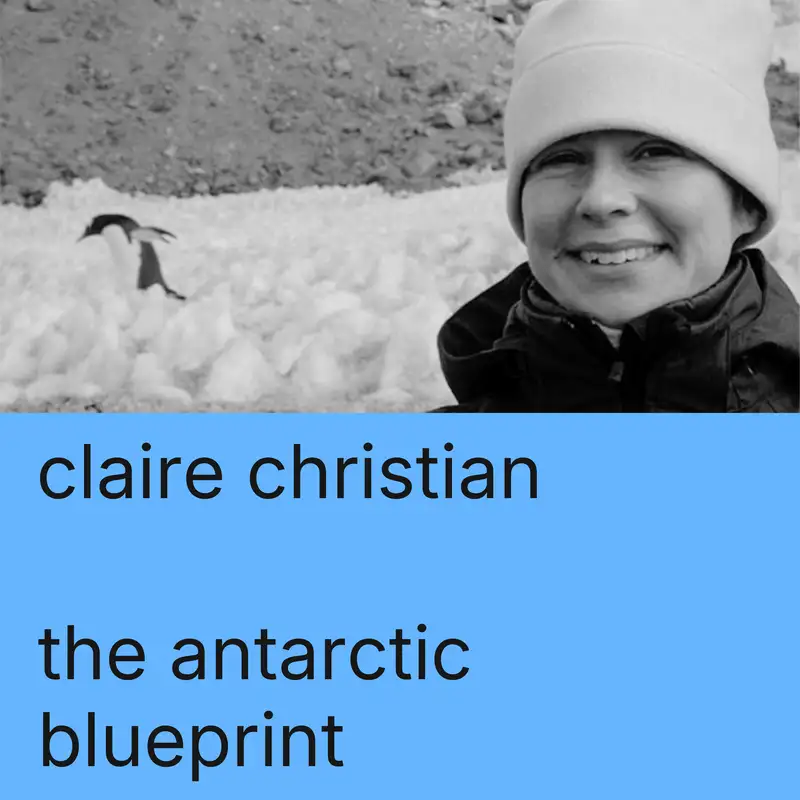
Someone who has a front-row seat to those conversations is Claire Christian, Executive Director of the Antarctic and Southern Ocean Coalition. ASOC is the only environmental organisation that participates directly in Antarctic Treaty meetings, so I was incredibly excited to speak with her.
Angus Hervey
Antarctica is a truly remarkable place.
It's somewhere we rarely think about, yet I think it stands as a symbol of what humanity is capable of. In many ways, it encapsulates so many of the challenges we're facing today.
The issues haven't been solved. There are real tensions and significant challenges ahead. Countries don't always agree on the way forward.
And yet, at the same time, Antarctica reminds us just how far we've already come.
INTERVIEW WITH CLAIRE CHRISTIAN
Amy Rose
You spend your days thinking about one of the most remote places on Earth.
How has Antarctica changed your worldview?
Claire Christian
Human beings are very good at separating things into neat categories because it helps us understand the world.
There's a law for this fishery in this part of the ocean. There's a law governing how vessels operate at sea. We've divided land into national borders, with rules about who can cross them and when.
But when you work on Antarctica, you realise that's a human-created reality. It's not the planet's reality.
Antarctica is part of a global climate and ocean system that affects all of us.
Sea levels are influenced by how much ice remains locked in the Antarctic ice sheet versus how much melts into the ocean. You begin to see that this really is one interconnected planet.
When we talk about challenges like climate change or biodiversity loss, I don't see them as problems that any one country can solve alone. They're challenges we have to solve together.
My ability to thrive as a human being is connected to people making decisions in other parts of the world. For me to thrive in Washington, D.C., people elsewhere also need to make decisions that benefit everyone.
Working on Antarctica encourages you to think on a planetary scale rather than just focusing on what's happening in your own backyard. That's still important—but when we're talking about climate change, you can't solve it inside little boxes.
Angus Hervey
You describe Antarctica as part of this global climate and ecological system.
Why is it so important? And in particular, why are marine protected areas in this region such a big deal?
Claire Christian
When it comes to climate, you really have to start with the ocean.
If you flatten out a globe, you'll see that all the world's oceans are interconnected. There's a map called the Spilhaus Projection that illustrates this beautifully. Antarctica sits right at the centre, with ocean currents flowing around it and then out into every other ocean before returning again.
That ocean is incredibly influential- not just because it provides food, but because it regulates the global climate.
When sea ice forms around Antarctica, the ice itself is fresh water, so the salt is left behind. That salty water becomes very dense and sinks to the ocean floor, where it circulates around the globe, carrying nutrients, heat and oxygen.
If less sea ice forms, that circulation changes. That can alter ocean currents, influence weather patterns near your home and affect marine ecosystems thousands of kilometres away by changing the flow of nutrients.
I once heard Antarctica described as the engine room of the planet, and I think that's a wonderful way of putting it.
Whether we realise it or not, what's happening in Antarctica affects every one of us.
Of course, Antarctica is also covered by ice. If that ice melts, sea levels rise. Even a relatively small increase can have devastating consequences for coastal communities around the world.
Keeping Antarctica frozen is incredibly important for humanity, particularly when so many people live near the coast.
Angus Hervey
Okay, what about marine protected areas in particular?
Claire Christian
I like to think of Antarctic environmental protection as a two-layered process.
At one level, there are the local challenges. Antarctica isn't completely untouched—there's fishing, tourism and other human activity. Then there's the broader challenge of global climate change.
Marine protected areas aren't designed to address climate change directly, but they are a local response to both increasing human activity and the impacts of a changing climate.
The science is very clear: marine protected areas, along with terrestrial protected areas, are among the best tools we have to protect biodiversity and help ecosystems become more resilient.
Areas with fewer human pressures tend to cope better when climate change occurs, and some parts of Antarctica are already warming very rapidly.
So marine protected areas are a local solution to a global problem. They're incredibly important because every part of the planet needs protected areas, and the Southern Ocean is no exception.
Angus Hervey
I really like that framing—a local solution to a global problem.
It reminds me of other conservation stories we've covered. I've been working as a solutions journalist for more than a decade, and I distinctly remember reporting on the protection of the Ross Sea back in 2015.
When it was established in 2016, it became the world's largest marine reserve, covering 1.55 million square kilometres.
What was the hardest part of getting that agreement across the line?
Claire Christian
Political will, basically.
The Ross Sea has been studied extensively over many years, and there was a dedicated team of scientists who built a very strong scientific case for the marine protected area.
It's home to a disproportionate number of penguins, seals and whales compared with other parts of the Southern Ocean, so the ecological argument was incredibly compelling.
The challenge was getting every member of CCAMLR—the Commission for the Conservation of Antarctic Marine Living Resources—on board.
No one had attempted anything on that scale before. At the time, it was the largest marine protected area in the world, and understandably some countries were reluctant because it placed restrictions on fishing.
Ultimately, it wasn't really a scientific challenge. It was a diplomatic one.
And I think that's still true for the marine protected areas currently being proposed. The global science is very strong. Everything we know tells us that marine protected areas are one of the best tools we have for protecting biodiversity.
Now we just have to get the politicians to agree.
Amy Rose
Claire, I'd love to dive a little deeper into the Treaty itself and what it takes to move things forward.
You've just come back from the 48th Antarctic Treaty Consultative Meeting in Japan. The Antarctic Treaty is such a remarkable example of countries working together, yet every year there are issues that remain unresolved. This year, one of them was additional protections for the emperor penguin.
When you're in those rooms, how do you hold that tension between a system that has achieved extraordinary things and one that sometimes isn't moving quickly enough?
Claire Christian
There is a real tension between the remarkable history of the Antarctic Treaty System and the way it operates today.
The agreements are built on incredibly ambitious principles. There's a strong commitment from many countries to preserving Antarctica.
But because every decision requires consensus, any one country can block a proposal for almost any reason. That's frustrating.
Take the emperor penguin. The proposal was to list it as a specially protected species under the Antarctic Treaty, which would trigger additional conservation measures. Many countries had invested years of work into developing both the proposal and an accompanying action plan.
To see that not succeed was deeply disappointing.
What helps me, though, is remembering that many of Antarctica's greatest conservation achievements also took years—sometimes decades.
My organisation was founded in the late 1970s, when Treaty Parties were discussing how mining should be regulated in Antarctica. Environmental organisations like ours campaigned for something much more ambitious: a complete ban on mining.
For years we were told that was unrealistic. We were told the best we could hope for was ensuring mining happened responsibly.
But they were wrong.
Today, Antarctica has a mining ban.
That didn't happen overnight. Negotiations stalled, countries disagreed, and at one point they had to start over. But what eventually emerged was the Environmental Protocol that now forms part of the Antarctic Treaty System.
I think that's an important lesson.
People can be deeply entrenched in their views, but over time you can build trust, share different perspectives and gradually bring people with you.
I hope we continue to invest in that trust and those shared values because Antarctica is at a critical moment.
There are practical steps we could take right now—like stronger protections for emperor penguins—and I'd hate to see those opportunities lost because of politics.
Amy Rose
I have so much respect for the work you do. I struggle to get my own family to agree on what we're having for dinner, let alone trying to get countries from around the world to agree on something. And unlike my family, you've also got a ticking clock in the background. What does it take to keep showing up year after year?
Claire Christian
Personally, I've always been someone who believes there's a way forward.
Right now, I think a lot of people are exhausted. Every day we're confronted with terrible news, and it can be hard not to feel overwhelmed.
For me, it's especially difficult seeing things I always considered strengths—support for science, medical research, multiculturalism—being questioned or dismantled.
But giving up only makes those things easier to lose.
It's easy to become cynical about where the world is heading.
But I was just at a meeting where I watched people spend hours in difficult conversations, trying to make progress on the emperor penguin issue.
Nobody is doing that for personal gain.
They're doing it because they genuinely care about Antarctica and want to protect it.
So yes, the headlines might say, "The negotiations failed." Of course we all want tangible outcomes.
But I also take hope from the fact that there are people who continue to show up, year after year, putting in extraordinary effort simply because they believe this place is worth protecting.
Most of the worthwhile things humanity has achieved have never been easy.
MID POINT REFLECTIONS
Angus Hervey
Amy, listening to Claire talk about these meetings I think it's just such a good reminder that it's not countries that are negotiating these things it's people but the reporting is always couched in terms of Norway has said this or China has said this or Russia has said this and when I was listening to Claire It just suddenly struck me, and I know this should be obvious, but it's not countries. What you're talking about here is people negotiating with other people, and obviously those people are representing the interests of their countries. But it's not a kind of bunch of monolithic blocks bumping into each other in an empty conference room. There are real people with real feelings, real emotional ups and downs, relationships that go back sometimes decades.
Amy Rose
Exactly. Like sometimes Japan and Sweden go out for a beer after a day of negotiations, you know? And I think the same people will often keep coming back to these meetings. So as well as the progress that happens or doesn't happen, it's every time these relationships build. And I know, I found something about that really comforting.
Angus Hervey
Yeah, that's how I felt as well. Also just to get my geek on, you know, in game theoretical terms, you've got a much greater chance of a better outcome if you have repeated interactions between two parties or multiple parties rather than one-off interactions. That if you can somehow open up the space for cooperation and you know that you're going to have to come back again to interact and negotiate, there is a greater chance of a win-win outcome in game theory. So that's the other thing I was thinking, which I don't know, maybe everyone thinks that when they're listening to conversations. But yeah, it all felt like game theory to me.
Amy Rose
The other thing I really loved is how she said what's happening in Antarctica is a local solution to a global problem. And there's something about still thinking about Antarctica in terms of this local kind of presence. And what is happening there is just really focused on what is happening there.
Angus Hervey
And Antarctica is also one of those weird places where it kind of sits in the back of our subconscious. and we don't really think about it that often, but every now and again, it kind of surfaces and suddenly it's in the news, right? Often for the wrong reasons.
INTERVIEW WITH CLAIRE CHRISTIAN
Angus Hervey
When you see Antarctica in the news, can you describe the gap between the way it's talked about and the Antarctica that you understand?
Claire Christian
One of the main things is that Antarctica has become this source of mysterious fascination. People ask, What's happening down there? What might happen in the future? Are countries going to end up in conflict over Antarctica?
One thing the media often talks about—and it's a bit of a pet peeve of mine—is the claim that the Antarctic Treaty is going to expire in 2048 and that the continent will suddenly be opened up to mining.
That's not accurate.
The mining ban is in place indefinitely. To remove it, countries would first have to negotiate a new legally binding international agreement, and then a large number of countries would have to ratify it.
Having spent many years attending international meetings, I can tell you these things take an incredibly long time—even when the decisions aren't legally binding.
I've seen delegates debate a non-binding resolution for hours.
So the idea that we'd simply wake up in 2048, decide to mine Antarctica and immediately start doing it is completely out of step with how the system actually works.
It's also out of step with how many countries think. A great many are genuinely proud that Antarctica has a permanent mining ban and that environmental protection sits at the heart of the Treaty System.
I don't think that suddenly changes just because the calendar does.
Angus Hervey
Can you tell us your favourite Antarctica story? The one you always pull out at a dinner party.
Claire Christian
One of the things that's so fascinating about visiting Antarctica is just how many rules you have to follow.
You have to stay well away from the wildlife. Only a certain number of people are allowed ashore at any one time.
It's one of the few places where what you want as a human matters a lot less.
You might want to walk closer to the penguins—but you can't.
There's even something called a penguin highway. Penguins follow the same paths up and down the beach, and if you step onto one, your guide will very quickly ask you to move. You're simply not allowed to block a penguin from getting to the ocean.
In our everyday lives, we rarely think about nature that way.
We don't stop and ask, What does nature need? We don't usually think about whether we're blocking an animal's path or stepping on a plant—we just do it.
But when you're surrounded by Antarctica's extraordinary wildlife and landscapes, and you realise you have to be mindful of every step you take so you don't disturb this incredible place, it changes the way you think.
What if we took that mindset home?
What if, instead of asking what we need and expecting nature to accommodate us, we asked what nature needs?
Instead of asking, How many trees can we cut down before something bad happens? we could ask, What does this forest need to stay healthy?—and then shape our actions around that.
That's a really powerful shift in perspective.
We're living through a time of climate change and biodiversity loss, and people understandably ask, What can we do?
I think one answer is to rethink our relationship with nature.
Antarctica gives you a chance to practise that.
Angus Hervey
You mentioned the wildlife. When I think of Antarctica, the first thing that comes to mind is a penguin. But you've got a bit of a soft spot for Antarctica's lesser-known invertebrates, haven't you?
Claire Christian
I do. I do. Beneath the surface there's this extraordinary world of invertebrate life. There are glass sponges that can live for 500 years, starfish with 50 arms that catch krill out of the water, and all sorts of weird and wonderful creatures.
When you see these little hotspots on the seafloor, they're like underwater gardens—covered in sea urchins, starfish, sponges and countless other species. They're far more colourful than most people imagine.
For me, it's a reminder that Antarctica isn't just ice and a few penguins. It's a rich, vibrant ecosystem, and many of these habitats are incredibly fragile and, thankfully, still largely untouched.
Angus Hervey
You mentioned those 50-armed starfish feeding on krill. Krill suddenly seems to be on everyone's radar.
How involved has ASOC been in that conversation, and what's happening with krill at the moment?
Claire Christian
Antarctic krill are a remarkable species because almost everything in Antarctica either eats krill or eats something that eats krill. The entire ecosystem is unusually dependent on this one animal.
Because there's so much krill, humans have found commercial uses for it, including omega-3 supplements and other nutritional products, and demand for those products is growing.
The reason a separate treaty was created to manage the Southern Ocean was because, even back in the late 1970s and early 1980s, people recognised that if too much krill was removed, the ecosystem could collapse.
Today, the main krill fishery operates around the Antarctic Peninsula, one of the fastest-warming places on Earth.
At the same time, whale populations are recovering, which means more whales are returning to feed in exactly the same areas where fishing is taking place.
So we're seeing several pressures converge at once.
I'm not worried about krill disappearing across the entire Southern Ocean.
What concerns me is that too much krill could be removed from the specific places where penguins, whales, seals and other wildlife depend on it.
Angus Hervey
Claire, this is a bit of a left-field question, but seeing as you're one of the world's experts on Antarctica...
Is the Thwaites Glacier on the verge of collapsing into the sea?
Claire Christian
I'm not a glaciologist, so I'm always cautious about answering questions outside my expertise.
But I can say that warming is happening much faster than many of us expected.
There is a real risk that Antarctica could reach certain tipping points sooner than we once thought.
Once those thresholds are crossed, glaciers can begin collapsing much more rapidly. Melting accelerates, and even if global emissions were reduced dramatically after that point, it becomes much harder to slow or reverse those processes.
Amy Rose
Claire, when we hear information like that, it can feel really stressful. Sitting here in Sydney, it sometimes feels like there's nothing I can do. What would you say to our listeners? How can ordinary people actually make a difference?
Claire Christian
It is a hugely complicated question, and I completely understand why people feel overwhelmed.
For me, the biggest thing we need right now is climate leadership.
Unfortunately, I think we're seeing a retreat from talking about climate change. Some leaders seem to think there's no point acting because another country isn't doing enough.
I think that's a very defeatist attitude.
Citizens need to hold their leaders accountable. If climate change isn't part of the conversation, we should demand that it is.
This isn't an issue we can afford to put off until it becomes politically convenient.
I've also heard people argue that individual actions don't matter—that recycling doesn't matter, or riding a bike to work doesn't matter because corporations produce far more emissions.
I actually think that's a very disempowering message.
It also ignores human nature.
People copy one another. When we see others acting responsibly, we're more likely to do the same.
The major climate reports consistently talk about the need for societal transformation.
Well, society is all of us.
It's made up of millions of small actions—including what we do with our own rubbish.
Those actions matter.
If we sit around waiting for one silver bullet that solves everything, we'll be waiting forever.
Everything starts somewhere.
Every major change begins as a small idea that gradually grows.
Angus Hervey
Hearing you speak about this and just knowing the little bit that we do about the way the world governs Antarctica, I think there is a good argument to be that that is the most successful model of planetary governance that we have in the world right now. What does that tell us about what is still possible in 2026?
Claire Christian
Well, I think it tells us that you can change people's values over time. When people started out with the Antarctic Treaty, they were not thinking they were going to be banning mining or creating marine protected areas. None of that was on the radar. But over time, that's become, to many people, a critical part of what the Antarctic Treaty system is supposed to do. In fact, that attitude seems to be coming expressed more and more strongly, I think, by some countries every year.
That makes me feel more positive about the Antarctic Treaty system is even though we're not able to achieve consensus. It's really a tiny minority that are blocking consensus. And in fact, we're seeing countries step up to do more in terms of Antarctic research and protection than they have historically. South Africa is working on a plan to identify areas for marine protected areas in the Southern Ocean, along with France and Australia. South Korea has become an important research player and is a strong voice for conservation of Antarctica. Japan, in their hosting of the Antarctic Treaty meeting this year, they put in an incredible amount of effort trying to get a result on the emperor penguin.
So we're seeing countries showing leadership at a time that is very difficult. And it just tells me that the principles of the Antarctic Treaty system do resonate with people still, and that countries can still look outside of their own national interest and think about what's best for the planet.
FINAL REFLECTIONS
Amy Rose
Gus, this is one of those conversations where I walked away having to hold those two ideas of that there are problems in Antarctica that we really need to address. And that the world can work together to solve things and to mend things. It actually made me really proud of us as a human race. I know there's a lot of things that we get wrong. but it is really lovely to hear a story not about just one person that's getting something right but representatives from every single country coming together and getting things right
Angus Hervey
I love that it's such a good reminder for me I think the symbolism of Antarctica just comes through so strongly in this conversation that it stands in as a symbol of international cooperation but also it's a place that is so important for so many other things that happen in the world. It regulates our currents and our temperatures, and it's this kind of forgotten, hidden place at the bottom of the world, and yet it's connected to everything else, and it's so important in so many ways. And what happens there, literally and figuratively, has knock-on effects that ripple across the face of the planet, and that is something that I think I will take away from this and that I will keep in mind. And in the meantime, I think I'll just keep on trying to work on my baby, not tripping up the alarms.
Creators and Guests